Why Ethereum is Still Undervalued in 2026

Tom Lee says Ethereum is vastly undervalued right now. If you watch the ETH/BTC ratio or simply compare market caps, Ethereum still lags Bitcoin in price performance despite materially improving fundamentals, growing institutional access, and a maturing scaling stack. That disconnect is the crux of the investment opportunity: the market is still valuing ETH as “tech-beta crypto” rather than as the settlement, computation, and collateral layer for tokenized finance and onchain commerce.
What should ETH holders and altcoin investors watch? Three things stand out:
– Whether Ethereum captures the lion’s share of real-world asset (RWA) tokenization flows
– Whether L2s convert lower fees into sustained user growth, fee revenue, and burns
– Whether ETH’s yield-plus-burn dynamics, plus spot ETF distribution, re-rate ETH from a narrative of “growth token” to “productive, yield-bearing internet commodity”
Below is the thesis for why, across the next five years, Ethereum’s fundamentals can outpace Bitcoin’s price performance, even if both assets appreciate—driven by tokenization, maturing scaling, and compounding network effects around smart contracts.
Tokenization as Ethereum’s Killer Use Case
Most crypto narratives come and go; tokenization keeps compounding. It’s not speculative, issuers, asset managers, and fintechs are already moving traditional assets onchain because it improves settlement, composability, and distribution. Multiple blue-chip research desks have projected multi-trillion-dollar tokenization by 2030. The question is not “if,” but “where.” Ethereum’s answer is increasingly compelling.
Why Ethereum?
1) Standards and Composability
– Token standards like ERC-20, ERC-721, ERC-1155, and for securities-style assets, frameworks such as ERC-1400/3643, give issuers a known path to compliance and transfer controls.
– ERC-4626 vaults standardize yield-bearing wrappers, simplifying money market funds, treasuries, and structured credit onchain.
– These standards are not just checkboxes; they’re the discipline that enables capital markets plumbing, custody, transfer restrictions, whitelists, and net-asset-value accounting—to snap together without bespoke integrations for every asset.
2) Settlement and Atomicity
– Onchain settlement enables delivery-versus-payment (DvP) in a single transaction, collapsing counterparty risk and T+2/T+1 operational complexity into near-instant finality.
– Collateral moves programmatically. The moment an asset is tokenized into an ERC standard, it can be used as collateral in lending markets, traded in AMMs or order books, and placed in structured products, without a new integration each time. That is the composability dividend.
3) Compliance-Ready Architectures
– Tokenization needs identity and permissioning. Ethereum’s ecosystem has matured here: permissioned pools (e.g., KYC-gated lending), onchain allowlists, and identity attestations let issuers meet regulatory requirements without forfeiting composability.
– Oracles and attestations matter. Reserve proofs, price feeds, and corporate actions (coupons, redemptions) can be automated via onchain schedules and oracle updates, reducing operational lift.
4) L2s Make the Economics Work
– Proto-danksharding (EIP-4844) reduced L2 data costs and enabled sub-cent to low-cent transactions on rollups, crucial for high-frequency capital markets tasks like coupon payments and order routing.
– Rollups like Optimistic and ZK designs (Arbitrum, Optimism, Base, zkSync, Starknet, Linea, Scroll, and others) let issuers segment use cases by latency, cost, and privacy while settling to Ethereum’s security and liquidity.
5) Stablecoins and Cash Management Live Here
– The largest dollar stablecoins originated in the Ethereum stack. For treasurers, this means tokenized treasuries and stablecoins can share the same pipes for subscriptions, redemptions, and hedges.
– Institutional wrappers—tokenized money market funds and short-duration treasuries—have already demonstrated real product-market fit by offering onchain subscriptions and intraday liquidity.
6) Early RWA Momentum Compounds
– Private credit, trade finance, receivables, treasuries, and even fund shares are moving onchain. Each new issuer reduces the friction for the next, because their vendors—custodians, transfer agents, auditors—adapt to Ethereum-first tooling.
– Tokenization isn’t only about cost. It broadens distribution. A fund share or note, once tokenized, can integrate into wallets, neobanks, and onchain marketplaces. That unlocks long-tail demand that legacy rails can’t cheaply reach.
The killer use case is not a single product—it’s the general-purpose, programmable balance sheet. Ethereum is the default habitat for that, because it already hosts the richest array of standards, liquidity, developer tooling, and L2s to meet different regulatory and performance profiles.
Why the Next Bull Cycle Favors ETH Over BTC
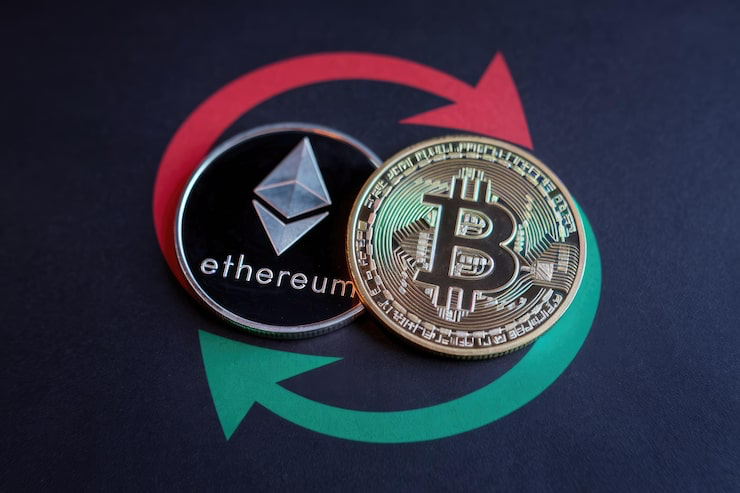
Bitcoin is the monetary base of crypto and will likely remain the largest single asset by market cap. But price performance within a bull cycle depends on marginal demand. Over the next five years, multiple marginal-demand engines are aligned behind Ethereum.
1) ETH is productive: yield plus burn
– Post-Merge, ETH issuance fell sharply. EIP-1559 continues to burn a portion of fees. When onchain activity rises, net supply can turn deflationary over intervals.
– Stakers earn real yield (fees + MEV + tips, minus dilution). As usage migrates to L2s, the base layer still captures blob fees and settlement demand—that’s revenue tied to economic activity across the whole L2 constellation. A growing economy increases cash flows to validators and intensifies the burn.
– This is a strong re-rating candidate: from “tech token” to “productive commodity” where holders receive an implicit share of network cash flows via staking and supply contraction dynamics.
2) Scaling is working and improving
– EIP-4844 was not the finish line; it was the on-ramp. Rollup costs fell, throughput rose, and application categories that were previously non-viable—micropayments, onchain social, high-frequency games, consumer DeFi—now have credible unit economics.
– As danksharding phases progress, data availability expands further, enabling rollups to scale without sacrificing Ethereum security. More transactions, more blobs, more fee burn.
3) Spot ETFs broaden distribution and legitimacy
– Spot ETH ETFs launched in 2024 provided a compliant wrapper for advisors, RIAs, and institutions to allocate. Distribution tends to lag approval: it takes time for platforms, model portfolios, and risk committees to integrate new exposures.
– The second and third waves of adoption—wealth platforms, retirement accounts, and non-U.S. mirrors—could unfold across 2025–2027 and beyond, steadily expanding marginal demand.
4) Tokenization flows accrue to the EVM
– Issuers prefer the path of least resistance: standards, liquidity, and integrations. The EVM has become the lingua franca for smart contracts. Even non-Ethereum L1s aim for EVM compatibility because it taps into existing tooling (Foundry, Hardhat), wallets, and auditors.
– As RWA markets grow, collateral and settlement gravity pull activity toward the deepest liquidity. That’s currently Ethereum L1 and its leading L2s.
5) Restaking and shared security
– Restaking introduces a new demand narrative: ETH as economic security rented to Actively Validated Services (AVSs). While risk management is paramount to avoid correlated slashing or systemic coupling, the direction is clear—ETH can secure more than Ethereum.
– If restaking matures responsibly, ETH becomes the base collateral for verification services, data layers, oracles, and app-chains. That can justify higher valuations by tying ETH to broader, multi-protocol cash flows—though with higher complexity and risk to monitor.
6) Developer and app velocity
– The number of production-grade libraries, security tools, and auditors in the Ethereum stack remains unmatched. Account abstraction (ERC-4337), session keys, and passkey wallets are shipping user experiences closer to Web2 norms.
– Consumer-grade UX plus low fees creates surface area for non-financial apps to find PMF—social graphs, identity, creator economies—adding non-correlated transaction flows beyond pure speculation.
7) Valuation frameworks are maturing
– Investors can now triangulate ETH value using multiple lenses: fee revenue/burn, staking real yield, ETF net inflows, L2 blob demand, and tokenization AUM. Bitcoin, by design, offers fewer cash-flow-like metrics beyond fee trends and adoption proxies.
– As more traditional analysts cover the space, the ability to model ETH as a productive digital commodity may compress the discount that comes from “it’s just a token.”
8) Regulatory optics are improving
– While regulatory dynamics vary by jurisdiction and remain non-linear, the existence of spot ETFs and long-standing commodity treatment by some agencies improve the perceived standing of ETH. That lowers the career risk for allocators to size positions over time.
Put together, these engines mean that even if Bitcoin preserves its monetary premium, Ethereum has a broader set of levers to grow cash flows, intensify burn, and justify multiple expansion.
What to Watch: Leading Indicators for an ETH Re-Rating
– ETH/BTC ratio and flows: Does the pair put in higher lows across the cycle? Do ETF flows broaden beyond early adopters?
– L2 economics: Sustained low fees, rising daily active addresses, and blob usage trending up indicate structural demand.
– RWA AUM on Ethereum: Growth in tokenized treasuries, private credit, and fund shares, plus secondary market depth.
– Staking dynamics: Staked percentage, validator distribution, realized yield (fees + MEV + tips), and burn rates during peak usage.
– Stablecoin settlement share: If Ethereum L2s claw back settlement share from alternative rails due to cheaper fees, that’s a powerful signal.
– Security externalities: MEV centralization, relay concentration, and restaking risk management—healthy decentralization supports premium valuations.
Risks and How to Contextualize Them
– Regulatory uncertainty: A sudden change in treatment for staking, tokens, or stablecoins could impact flows. Mitigation: Diversified jurisdictions, permissioned pools, and institutional wrappers.
– L2 fragmentation: Too many rollups can dilute liquidity. Mitigation: Shared sequencing, intent-based order flow, and better bridging/settlement frameworks can restore effective composability.
– Restaking contagion: Poor risk controls could propagate slashing events. Mitigation: Conservative AVS design, caps, and clearer separation of duties.
– Security and UX: Smart contract risk remains. Mitigation: Formal verification, audits, insurance, and gradual decentralization of sequencers.
– Competing ecosystems: While EVM is dominant, credible alternatives can win verticals. The counter to this is Ethereum’s modularity and willingness to adopt what works (e.g., ZK rollups, account abstraction).
Verdict: Smart Contract Dominance and Network Effects
The market still prices Ethereum mostly as a “fast follower” to Bitcoin’s cycles. That view misses a structural shift: Ethereum is not just a store of value narrative—it’s the programmable settlement and collateral layer of the internet economy. Tokenization is the forcing function; L2 scaling is the distribution; spot ETFs and staking are the financial wrappers that let institutions participate; and EVM dominance provides the gravitational field that keeps builders and liquidity in orbit.
Across the next five years, this is the base case:
– Tokenization scales from pilot to platform. Treasuries, money markets, and private credit grow first; real estate and trade finance follow with improved tooling. Each step increases the share of onchain settlement occurring on Ethereum L1/L2.
– L2s absorb consumer-scale throughput, with danksharding phases unlocking further cost declines. App categories beyond finance contribute durable activity and fee burn.
– ETH’s valuation framework normalizes around cash-flow-like metrics (fees, burns, yields), reducing the discount created by narrative uncertainty. ETF penetration matures, not as a flash-in-the-pan, but as a slow-moving inclusion into diversified portfolios.
None of this requires maximalist assumptions. Bitcoin can succeed on its own trajectory as pristine collateral and macro hedge. The core claim is narrower: the marginal demand drivers that matter for price performance inside a bull cycle—tokenization, scalable UX, productive yield, and distribution via regulated wrappers—are now more aligned with Ethereum than ever before.
So, is Ethereum still undervalued in 2027? On a five-year view, yes—if you believe:
– Tokenized assets settle and compose where standards, liquidity, and developers live
– L2 economics convert cheaper blockspace into durable, non-speculative activity
– Investors re-rate ETH as a productive, yield-bearing asset with structural burn
The future is not predetermined. Watch the metrics. But if the thesis holds, ETH’s lag relative to BTC becomes an opportunity, not a warning sign. In that world, 2027 won’t mark the end of Ethereum’s upside—it’ll read as the middle chapters of the smart-contract era taking over finance.
Disclosure: This is educational analysis, not investment advice. Do your own research and consider your risk tolerance.
Frequently Asked Questions
Q: Why does tokenization favor Ethereum over other chains?
A: Because Ethereum offers the deepest combination of standards (ERCs), liquidity, developer tooling, security, and L2 scalability. Issuers want predictable compliance features, easy integrations, and access to capital. The EVM has become the default for smart contracts, which compounds network effects.
Q: How do L2s help ETH value if most transactions move off L1?
A: Rollups post data back to Ethereum via blobs and settle state to L1. That activity generates fees and burn on the base layer while enabling orders-of-magnitude more transactions. As L2 usage rises, Ethereum still accrues value through data availability and settlement demand.
Q: What makes ETH a ‘productive’ asset?
A: Validators earn fees, tips, and MEV, while EIP-1559 burns a portion of transaction fees. This creates a yield-plus-burn dynamic that can reduce net supply during busy periods. Stakers effectively share in the network’s cash flows, unlike assets without analogous mechanisms.
Q: Could Bitcoin outperform anyway?
A: Yes. Macro shocks, liquidity cycles, or renewed institutional focus on digital gold could drive BTC leadership. The thesis here is that the marginal demand drivers for the next leg—tokenization, scaling-enabled apps, staking yields, and ETF penetration—skew toward Ethereum.
Q: What are the biggest risks to the Ethereum thesis?
A: Regulatory shifts, L2 fragmentation, security incidents (smart contracts or MEV centralization), and restaking externalities. These risks are real but manageable with better standards, audits, decentralization of sequencing, and prudent risk caps for restaking.
Q: What metrics should I track to validate or falsify this view?
A: Watch: ETH/BTC ratio, ETF net flows, L2 blob usage and gas prices, RWA AUM issued on Ethereum standards, staking participation and realized yields, stablecoin settlement share on Ethereum vs. alternatives, and validator/relay decentralization.
Q: Does ETF approval alone guarantee an ETH re-rating?
A: No. ETFs expand distribution, but sustained performance requires real network usage. The re-rating case strengthens if tokenization and L2-driven apps drive persistent fees and burn, making ETH’s cash-flow-like profile undeniable.