
Look Expensive: Budget Gift Shopping Without Looking Cheap: Expensive-Looking Gifts on a $20 Budget
Introduction: The Art of Budget Gift-Giving
There’s a common misconception that meaningful gifts require deep pockets. The truth? With strategic shopping and thoughtful presentation, a $20 budget can yield gifts that rival those costing three times as much. The secret isn’t about finding cheap items—it’s about identifying quality pieces at accessible price points and presenting them with intention.
The difference between a gift that looks cheap and one that looks thoughtful has little to do with the actual price tag. It’s about understanding value markers, knowing where to shop, and mastering presentation techniques that signal care and consideration. Whether you’re shopping for holidays, birthdays, or just because, this guide will transform how you approach budget gift-giving.
Trade Your Gift Card With Xbanka
Stores and Sections with Best Value-for-Money Items
HomeGoods and TJ Maxx Home Décor Sections
These treasure hunt stores are goldmines for gift-givers on a budget. The key is knowing what to look for:
Best buys under $20:
– Designer candles (often $8-15 for brands that retail for $30+)
– Turkish cotton hand towels in beautiful patterns
– Ceramic planters and small decorative bowls
– Gourmet food items and specialty olive oils
– Picture frames and small wall art
Shopping strategy: Visit weekly if possible, as inventory changes rapidly. Head to the clearance endcaps first—that’s where you’ll find luxury brands at 50-70% off. Look for items with intact original tags from high-end brands, which add to the perceived value.
What to avoid: Anything that looks obviously seasonal or trendy unless you’re shopping for the current season. Passed-over holiday items have “discount store” written all over them.
Target’s Threshold and Opalhouse Lines
Target’s private labels punch well above their price point in terms of quality and design.
Top gift picks:
– Threshold kitchen textiles (tea towels, pot holders) – $4-8 each, buy multiples
– Opalhouse decorative accessories (small vases, catch-all dishes) – $10-15
– Studio McGee collaboration items when on sale
– Project 62 minimal home items
– Threshold ceramic mugs with gold accents – usually under $8
Pro tip: Stack Target Circle offers with RedCard savings (5% off) and shop clearance sections. A $25 item marked down to $17.48 with an additional 5% off comes in just under $17—and looks like you spent much more.
Trader Joe’s Specialty Food Items
TJ’s is a secret weapon for food gifts that appear gourmet.
Gift-worthy items:
– Truffle products (truffle salt, truffle powder, truffle cheese) – $3-6
– Specialty olive oils and aged balsamic vinegar – $5-8
– Unique tea collections and coffee – $4-7
– Dark chocolate bars (the sea salt varieties) – $2-3
– Everything But the Bagel seasoning and other spice blends – $2-4
Assembly strategy: Combine 3-4 items for a gourmet food gift under $20. For example: truffle salt ($4) + fancy olive oil ($7) + artisan crackers ($4) + specialty cheese ($4) = $19 of curated deliciousness that could easily appear to be a $40+ gift.
Barnes & Noble Gift Sets and Specialty Items
The bookstore offers more than just books when it comes to gifts.
Hidden gems:
– Mini book sets (classic literature collections) – $12-18
– Journal and pen sets – $15-18
– Specialty puzzles from small publishers – $15-20
– Book lover accessories (reading lights, bookmarks, book stands) – $8-15
– Criterion Collection DVDs on sale – often $19.99
Value play: The pre-made gift sets look intentionally curated. A journal set that includes a quality notebook and two pens for $16.99 would cost $25-30 if you assembled it yourself from individual premium items.
Dollar Tree Hidden Gems (When Curated Carefully)
Yes, Dollar Tree can be part of your gift strategy—but only specific items:
Actually good options:
– Clear glass vases (to use as gift packaging containers)
– Seasonal hand towels (surprisingly decent quality)
– Baskets for assembling gift sets
– Tissue paper and cellophane for presentation
– Name-brand candy and snacks for gift basket filler
Critical rule: Dollar Tree items should be components, not the entire gift. Use their products for presentation materials and fillers, not as standalone gifts.
Presentation Tricks That Elevate Budget Gifts
The Power of Quality Wrapping Materials
Investment in presentation pays massive dividends in perceived value.
Worth spending on:
– Thick, textured wrapping paper or kraft paper – $4-6
– Quality ribbon (grosgrain or velvet, not curling ribbon) – $3-5
– Gift tags or small cards with blank interiors – $3-4
– Tissue paper in neutral colors – $2-3
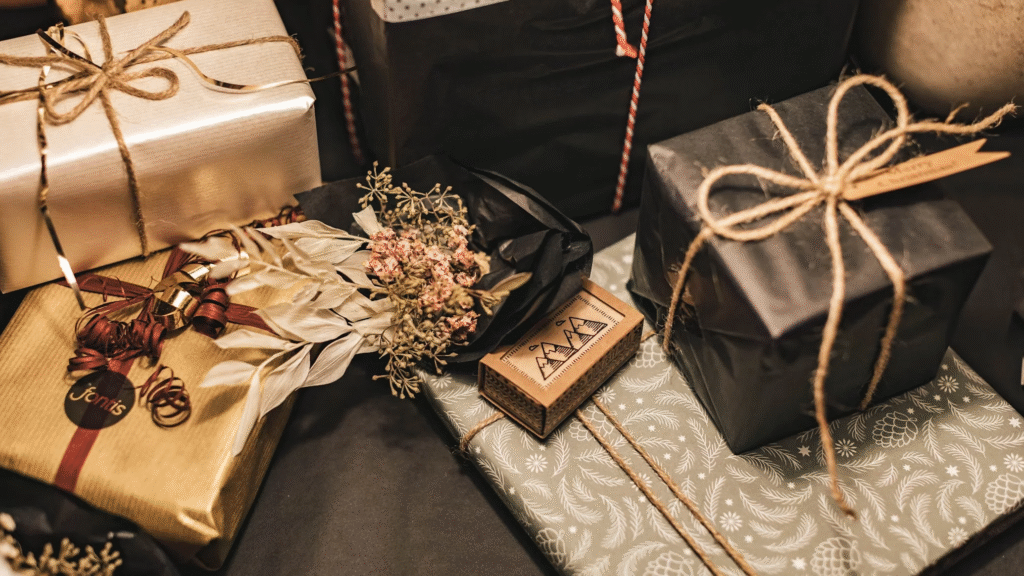
Wrapping technique: Clean, precise folds matter more than fancy bows. Use the department store approach: crisp corners, minimal tape visible, ribbon tied simply but securely. A $12 gift in $5 worth of quality wrapping looks more expensive than a $20 gift in $1 wrapping paper.
The hack: Buy solid-colored wrapping paper and elevate it with natural elements (sprigs of rosemary or eucalyptus tucked into the ribbon, which costs pennies) or a simple wax seal (seal kits are $10-15 and can be used for dozens of gifts).
Layering and Presentation Techniques
How you reveal a gift affects its perceived value.
The box-within-a-box method:
1. Place the actual gift in tissue paper
2. Put it in a nice (but inexpensive) box from The Container Store or craft stores – $2-4
3. Wrap the box rather than giving it in a gift bag
4. The unwrapping experience adds anticipation and value
The basket approach:
1. Use an inexpensive basket as your “wrapping” – $3-6
2. Line it with shredded paper or tissue – $2
3. Arrange items by height with tallest in back
4. Wrap the entire basket in clear cellophane – $2
5. Tie with a substantial ribbon on top – $3
6. Total presentation cost: $10-13, but looks like a $50+ gift basket
Adding Personal Touches That Signal Thoughtfulness
Personalization is the ultimate value multiplier for budget gifts.
Low-cost personalization:
– Handwritten note cards explaining why you chose each item
– Custom tags made with cardstock and calligraphy (or nice handwriting)
– Printed labels with the recipient’s name or initial
– Recipe cards included with food items showing how to use them
– Small photos printed at Walgreens ($.25 each) tucked into the gift
The story technique: When giving the gift, have a brief story ready about why you selected it. “I remembered you mentioned loving lavender, so when I found this lavender honey, I thought of you.” The narrative adds emotional value that transcends price.
Container Strategy: Reusable Gift Packaging
Package your gift in something that’s also a gift.
Double-duty containers:
– Mason jars or glass canisters (fill with cookies, then they keep the jar) – $3-5
– Decorative tins (fill with tea or treats) – $4-6
– Small planters or flower pots (fill with gardening supplies or candy) – $3-7
– Kitchen colanders or mixing bowls (fill with baking ingredients) – $8-12
– Coffee mugs (fill with hot cocoa mix, candy, or coffee) – $6-10
Example: A $7 ceramic colander filled with $3 pasta, $4 gourmet sauce, and $2 Italian seasoning = $16 total, but presents as a thoughtfully curated Italian dinner kit worth $30+.
Convert Your gift Card To Cash On Xbanka
Combining Small Items for Bigger Perceived Value

Themed Gift Baskets on a Budget
Multiple small items always appear more valuable than one item at the same price point.
Spa basket ($20):
– Face mask – $3
– Small bottle of nice lotion – $4
– Bath bomb – $2
– Candle – $5
– Small towel – $3
– Basket and presentation – $3
Coffee lover basket ($19):
– Bag of specialty coffee – $7
– Biscotti or coffee cookies – $4
– Unique mug – $5
– Small bag of chocolate-covered espresso beans – $3
Movie night basket ($20):
– Microwave popcorn (3-4 bags) – $3
– Candy theater boxes – $4
– $10 digital movie rental gift card – $10
– Cozy socks – $3
The Psychology of Multiple Items
Why does this work? The abundance principle.
Perceived value factors:
– Variety signals effort: Multiple items suggest you spent time curating
– Physical presence: Several items take up more space, suggesting greater investment
– Usefulness multiplication: Each item has a moment of “oh, nice!”
– The unwrapping experience: Multiple reveals feel more exciting than one
The magic number: 4-6 items seems to be the sweet spot. Fewer than four can feel sparse; more than six can feel cluttered or overwhelming (unless they’re very small items like candies).
Strategic Pairings That Look Intentional
Some items naturally elevate each other when paired.
Winning combinations:
– Book + bookmark + tea/coffee ($18 total, feels like $35)
– Nice cheese + crackers + small cutting board ($20, feels like $40)
– Candle + matches + small tray ($17, feels like $35)
– Plant + decorative pot + plant food ($19, feels like $40)
– Wine/bottle + wine accessories like stopper or aerator ($20, feels like $40)
– Notebook + 2-3 nice pens ($16, feels like $30)
Pairing principle: Choose items that tell a story together. The connection should be obvious—they support or enhance each other’s use.
DIY Gift Set Ideas Under $20
Breakfast in bed kit:
– Pancake mix – $4
– Syrup – $4
– Coffee or tea – $5
– Nice napkins – $3
– Recipe card with a personal note – $0.50
– Presented in a serving tray – $3.50
– Total: $20
Cocktail/mocktail kit:
– Specialty mixer or juice – $4
– Garnishes (like fancy cherries or olives) – $4
– Recipe cards for 2-3 drinks – $1 (printed)
– Nice cocktail napkins – $3
– Bar tool (muddler, jigger, or strainer) – $6
– Presented in a shaker or glass – $2
– Total: $20
Self-care kit:
– Sleep mask – $4
– Herbal tea – $4
– Journal – $6
– Nice pen – $3
– Calming room spray – $3
– Total: $20
Gardener’s kit:
– Packet of seeds (3-4 varieties) – $8
– Small garden tools – $5
– Gardening gloves – $4
– Packet of plant markers – $3
– Total: $20
Baker’s kit:
– Unusual extract (vanilla bean, almond, etc.) – $5
– Specialty flour or sugar – $4
– Cookie cutters – $3
– Decorating items – $4
– Recipe card – $1
– Wooden spoon – $3
– Total: $20
Making Budget Sets Look Premium
Elevation techniques:
1. Remove price tags completely: Use Goo Gone if needed. Visible price tags immediately signal “bargain.”
2. Create a typed inventory card: List the items on nice cardstock as if you’re presenting a curated collection. “Your coffee lover’s collection includes: Ethiopian single-origin coffee, handmade biscotti, artisan mug, and dark chocolate espresso beans.”
3. Use uniform containers: If items come in mismatched packaging, transfer them to matching jars or containers (Dollar Tree has great glass options).
4. Arrange by height and color: In baskets or boxes, create visual appeal through intentional arrangement. This signals care and curation.
5. Add a “made especially for you” tag: Even if you didn’t make the items, the phrase suggests personalization and thought.
Conclusion: Thoughtfulness Over Price Tags
The most memorable gifts aren’t necessarily the most expensive—they’re the ones that feel personal, intentional, and thoughtful. With a $20 budget and the strategies outlined above, you can give gifts that:
– Reflect the recipient’s interests and personality
– Feel more valuable than they cost
– Demonstrate that you invested time and thought
– Create positive associations with your generosity
Remember these core principles:
Shop strategically: Know which stores offer the best value for gift-worthy items. Discount doesn’t mean cheap when you’re shopping at HomeGoods, TJ Maxx, Target’s premium lines, and specialty stores like Trader Joe’s.
Present intentionally: Quality wrapping and thoughtful presentation multiply perceived value. A $5 investment in presentation can make a $15 gift feel like $40.
Combine wisely: Multiple coordinated items create abundance and show curation. Four $5 items feel more generous than one $20 item.
Personalize meaningfully: The story behind the gift—why you chose it, how it connects to the recipient—adds immeasurable value that no price tag can match.
Budget gift-giving isn’t about being cheap; it’s about being clever, thoughtful, and strategic. Master these techniques, and you’ll never again stress about giving impressive gifts on a limited budget. The secret is out: thoughtfulness and presentation trump price tags every single time.
Your $20 can absolutely compete with someone else’s $50—and often, it can win.
Frequently Asked Questions
Q1: How can I make a cheap gift look expensive?
A: Focus on three key areas: quality presentation (invest in nice wrapping paper and ribbon), strategic shopping (buy from stores that offer designer items at discount prices like HomeGoods or TJ Maxx), and combining multiple smaller items into a curated gift set. Remove all price tags, use reusable containers as gift packaging, and add personal touches like handwritten notes explaining why you chose the items.
Q2: What stores have the best budget gift options?
A: HomeGoods and TJ Maxx excel for designer home items and candles at 50-70% off retail. Target’s Threshold, Opalhouse, and Studio McGee lines offer high-quality items at accessible prices. Trader Joe’s is perfect for gourmet food gifts that look expensive. Barnes & Noble has well-curated gift sets, and Dollar Tree can provide presentation materials like baskets, vases, and tissue paper (though not standalone gifts).
Q3: Is it better to buy one nice gift or multiple cheaper items?
A: Multiple coordinated items almost always have higher perceived value than a single item at the same price point. 4-6 smaller items create an abundance effect, offer variety in the unwrapping experience, and demonstrate curation effort. For example, a $20 gift basket with five themed items feels more generous than a single $20 item, even if the actual cost is identical.
Q4: How much should I spend on gift wrapping and presentation?
A: Allocate about 20-25% of your budget to presentation for maximum impact. For a $20 gift, spending $4-5 on quality wrapping paper, ribbon, a nice box or basket, and tissue paper can double the perceived value. The investment in presentation materials pays off significantly—a $15 gift in $5 worth of quality wrapping looks more expensive than a $20 gift in $1 wrapping.
Q5: What are good gift basket ideas for under $20?
A: Effective theme baskets include: spa basket (face mask, lotion, bath bomb, candle, towel), coffee lover’s basket (specialty coffee, biscotti, unique mug, chocolate espresso beans), breakfast kit (pancake mix, syrup, coffee, nice napkins in a serving tray), or movie night basket (popcorn, candy, streaming gift card, cozy socks). Choose 4-6 complementary items that tell a cohesive story.
Q6: How can I personalize budget gifts without spending more money?
A: Add handwritten note cards explaining why you chose specific items, create custom tags with the recipient’s name or initial, include recipe cards showing how to use food items, print small personal photos for $.25 each at drugstores, or create a typed inventory card that presents the items as a curated collection. The story and thought behind the gift add emotional value that costs nothing but means everything.
Q7: What items should I avoid when shopping on a budget?
A: Avoid anything with visible branding from known discount stores, passed-over seasonal items that look dated, overly trendy items that might not match the recipient’s taste, anything that looks plasticky or flimsy (go for fewer, higher-quality items instead), and items that come in obviously cheap packaging that can’t be easily improved with re-packaging or presentation.
Q8: Can I use Dollar Tree items in gift baskets?
A: Yes, but strategically. Use Dollar Tree for presentation materials (clear vases, baskets, tissue paper, cellophane), name-brand candy and snacks as fillers, and seasonal hand towels or kitchen items when quality is surprisingly good. Never use Dollar Tree items as the primary or only gift—they should be components or packaging, not the main event. The bulk of your budget should go toward higher-quality central items from other stores.