


Introduction: The BTC vs ETH Allocation Dilemma for 2026

As portfolio managers construct cryptocurrency allocations for 2026, the fundamental question remains: how should capital be distributed between Bitcoin and Ethereum? While both assets have demonstrated institutional viability, their value propositions, risk profiles, and catalysts diverge significantly heading into 2026.
This analysis examines the specific factors likely to drive performance differentiation between BTC and ETH throughout 2026, providing portfolio managers with a framework for strategic allocation decisions. Rather than viewing this as a binary choice, sophisticated allocators recognize that optimal positioning requires understanding the distinct risk-return characteristics of each asset.
The 2026 landscape presents unique conditions: Bitcoin continues maturing as a macro asset amid global monetary uncertainty, while Ethereum faces both transformational technical upgrades and intensifying Layer 1 competition. Portfolio managers must evaluate which catalysts present more compelling asymmetric opportunities.
Bitcoin’s Macro Tailwinds vs Ethereum’s Technical Upgrades

Bitcoin’s Macro Positioning for 2026
Bitcoin enters 2026 with fundamentally different macro dynamics than previous cycles. The asset has achieved unprecedented institutional legitimization through spot ETF adoption, with over $60 billion in AUM demonstrating sustained institutional demand beyond speculative phases.
The 2026 macro environment favors Bitcoin’s core value proposition as digital scarcity. With global debt exceeding $300 trillion and central banks maintaining expansionary bias despite inflation concerns, Bitcoin’s fixed supply schedule provides portfolio managers with a non-sovereign store of value increasingly correlated with monetary debasement fears rather than risk assets.
Geopolitical fragmentation accelerates Bitcoin adoption as neutral settlement infrastructure. As currency weaponization increases—evidenced by sanctions expansion and de-dollarization trends—Bitcoin’s censorship-resistant properties attract sovereign and institutional treasuries seeking apolitical reserve assets. Several nation-states are expected to formalize Bitcoin reserve policies in 2026, creating structural demand independent of price action.
The post-halving supply dynamics entering 2026 create technical tailwinds. With miner issuance reduced to approximately 164,000 BTC annually, even modest institutional accumulation creates supply deficits. ETF inflows averaging $200-300 million daily represent 5-7x current issuance, establishing sustained buy pressure that historically precedes significant appreciation phases 12-18 months post-halving.
Ethereum’s Technical Evolution
Ethereum’s 2026 performance thesis centers on the execution of its technical roadmap rather than macro narratives. The Pectra upgrade, scheduled for Q2 2026, delivers account abstraction improvements and validator efficiency enhancements that materially improve user experience and staking economics.
Account abstraction represents Ethereum’s most significant UX improvement since the Merge. By enabling smart contract wallets as the default, Ethereum addresses the primary friction point limiting mainstream adoption. Portfolio managers should recognize this as infrastructure enabling exponential user growth rather than an immediate price catalyst—similar to how the Merge created long-term deflationary economics before price impact materialized.
Ethereum’s staking yield dynamics present compelling income generation unavailable in Bitcoin. With approximately 28% of ETH supply staked generating 3-4% yields, Ethereum offers portfolio managers cash-flow characteristics more analogous to traditional fixed income with asymmetric upside. As institutional custody solutions mature, this yield component becomes increasingly relevant for fiduciary allocation decisions.
However, Ethereum faces intensifying Layer 1 competition that Bitcoin largely avoids. Solana, Avalanche, and emerging chains capture market share in high-throughput applications, while Layer 2 solutions fragment Ethereum’s value capture. Portfolio managers must assess whether Ethereum’s technical superiority translates to a sustained economic moat as execution environments commoditize.
Comparative Catalyst Timing
Bitcoin’s catalysts are predominantly macro-driven and externally originated: monetary policy deterioration, geopolitical instability, and institutional allocation mandates. These factors operate independently of Bitcoin’s development roadmap, creating catalysts less dependent on execution risk.
Ethereum’s catalysts require flawless technical execution of complex upgrades while maintaining network security and decentralization. The Pectra upgrade, while transformational, introduces implementation risks and potential delays that could disappoint markets expecting specific delivery timelines.
For 2026 specifically, Bitcoin benefits from well-established post-halving cycle dynamics and ETF infrastructure already operational. Ethereum faces binary outcomes around upgrade execution and whether technical improvements translate to value accrual amid Layer 2 cannibalization concerns.
Institutional Preference Trends Between BTC and ETH
Regulatory Clarity Differentiation
Bitcoin maintains decisive regulatory advantages entering 2026. Classified as a commodity by the CFTC and explicitly excluded from securities regulations, Bitcoin offers institutional investors clarity unavailable for Ethereum. This distinction matters critically for pension funds, endowments, and registered investment advisors operating under fiduciary standards.
Ethereum’s regulatory status remains ambiguous despite spot ETF approval. The SEC’s refusal to classify ETH definitively as a commodity creates ongoing uncertainty around staking services, DeFi protocols, and token issuances on Ethereum. Portfolio managers at regulated institutions face compliance complexity with Ethereum allocations that Bitcoin positions avoid entirely.
The 2026 regulatory environment likely brings increased enforcement rather than comprehensive clarity. Under this scenario, Bitcoin’s unambiguous status provides risk mitigation while Ethereum faces potential reclassification attempts, particularly if political winds shift. Conservative institutional mandates favor assets with settled regulatory treatment.
Custody and Infrastructure Maturity
Bitcoin’s custody infrastructure has achieved institutional-grade across multiple qualified custodians with insurance products, auditing standards, and operational track records spanning years. Coinbase Custody, Fidelity Digital Assets, and BitGo offer portfolio managers institutional-quality solutions with regulatory compliance and insurance coverage.
Ethereum custody introduces complexity around staking, smart contract interactions, and yield generation. While infrastructure has improved substantially, institutional custody solutions for staked ETH with full liquidity and regulatory compliance remain less mature than Bitcoin alternatives. Portfolio managers must evaluate counterparty risks and operational complexity when implementing ETH positions with yield generation.
The ETF vehicle preference reveals institutional sentiment. Bitcoin ETFs accumulated over $60 billion AUM within their first year, while Ethereum ETFs attracted approximately $10 billion—a 6:1 preference ratio despite Ethereum representing roughly 30% of Bitcoin’s market capitalization. This allocation disparity suggests institutional capital defaults toward Bitcoin when deploying through traditional finance vehicles.
Portfolio Construction Rationale
Institutional portfolio construction increasingly treats Bitcoin and Ethereum as distinct asset classes rather than interchangeable cryptocurrencies. Bitcoin functions as digital gold—a macro hedge and store of value with low correlation to technology sector risks. Ethereum represents technology infrastructure exposure with cash flow generation but higher execution and competitive risks.
This bifurcation suggests different allocation rationales. Bitcoin positions within portfolios increasingly serve as alternative to gold, treasury inflation-protected securities, or monetary debasement hedges. Ethereum allocations function as venture-like exposure to decentralized infrastructure adoption, accepting higher volatility for technology upside exposure.
Portfolio managers observe correlation patterns supporting diversification benefits. During 2024-2025, Bitcoin increasingly decorrelated from tech equities during market stress, while Ethereum maintained higher correlation to risk assets. This pattern suggests Bitcoin provides superior portfolio diversification for traditional 60/40 constructions, while Ethereum serves as satellite position for growth-oriented mandates.
Capital Allocation Trends
Corporate treasury adoption strongly favors Bitcoin over Ethereum. MicroStrategy’s Bitcoin treasury strategy, replicated by multiple public companies, has no equivalent in Ethereum corporate adoption. The treasury reserve case for Bitcoin—permanent, apolitical, verifiable scarcity—doesn’t translate to Ethereum’s technology platform narrative.
Sovereign wealth funds and nation-state adoption similarly skew toward Bitcoin. El Salvador’s Bitcoin legal tender adoption, rumored sovereign accumulation programs, and strategic reserve discussions exclusively reference Bitcoin rather than Ethereum. This sovereign bid represents potentially enormous demand unique to Bitcoin’s positioning.
Conversely, development activity and application-layer investment favor Ethereum ecosystems. Portfolio managers seeking exposure to DeFi, tokenization, and decentralized applications naturally gravitate toward Ethereum and its Layer 2 ecosystem. This creates distinct institutional segments: macro/treasury allocators prefer Bitcoin, while technology and venture investors favor Ethereum.
Risk-Adjusted Return Expectations for Both Assets
Volatility and Drawdown Characteristics
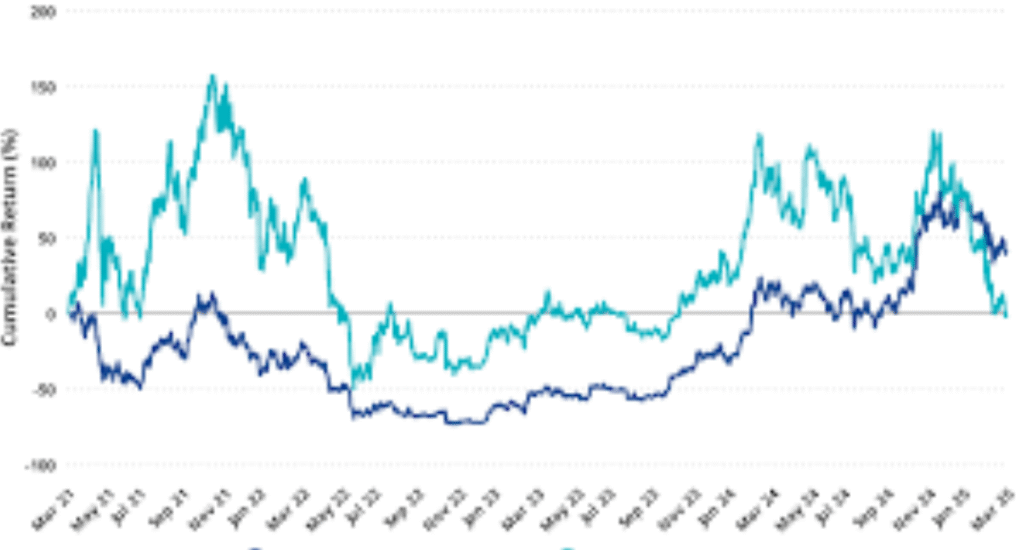
Historical volatility patterns show Ethereum exhibiting 1.2-1.5x Bitcoin’s volatility across market cycles. This higher volatility creates both opportunity and risk: Ethereum typically outperforms Bitcoin in bull markets by 50-100% but underperforms in bear markets by similar margins. Portfolio managers must assess whether current market conditions favor high-beta or defensive positioning.
The 2026 outlook suggests mixed volatility drivers. Macro uncertainty from geopolitical tensions and monetary policy confusion typically favors lower-volatility assets, suggesting Bitcoin outperformance. However, if risk appetites expand during 2026, Ethereum’s higher beta could generate superior returns, particularly if technical upgrades catalyze adoption acceleration.
Maximum drawdown analysis favors Bitcoin’s risk profile. During the 2022 bear market, Bitcoin declined approximately 77% peak-to-trough, while Ethereum fell 82%. More importantly, Bitcoin recovered its previous all-time high faster than Ethereum in subsequent cycles, suggesting superior risk-adjusted performance through complete market cycles.
Upside Scenarios and Return Potential
Bitcoin’s upside scenarios for 2026 center on institutional allocation increasing from current 1-2% of addressable institutional capital to 5-10%. If pension funds, sovereign wealth funds, and corporate treasuries expand Bitcoin allocations to match gold positions (typically 2-5% of portfolios), this represents $500 billion to $1 trillion in incremental demand against Bitcoin’s $1.2 trillion market cap—potentially doubling prices from current levels.
The nation-state adoption scenario presents extreme upside. If major economies formalize Bitcoin strategic reserves at even 1% of foreign exchange reserves, this represents over $1 trillion in sovereign demand. While low probability for 2026, even partial movement toward sovereign adoption creates asymmetric upside unavailable in traditional portfolio assets.
Ethereum’s upside scenarios require successful technical execution combined with application-layer adoption. If Pectra upgrades enable 10x user growth through improved UX, and Ethereum captures meaningful share of real-world asset tokenization (projected $10-16 trillion market by 2030), ETH could appreciate 3-5x. However, this scenario requires multiple assumptions proving correct simultaneously, introducing execution risk.
The DeFi and staking yield scenario provides more certain upside for Ethereum. With staking yields of 3-4% and potential fee revenue from increased network activity, Ethereum offers 5-8% yield potential plus price appreciation. Using traditional equity valuation multiples, if Ethereum generates $5-10 billion in annual fee revenue, a 20-30x revenue multiple suggests $100-300 billion in value beyond current levels—representing 30-100% upside independent of narrative speculation.
Downside Risks and Loss Scenarios
Bitcoin’s primary downside risks for 2026 involve regulatory crackdowns or competing digital currencies undermining the scarcity narrative. If central bank digital currencies (CBDCs) successfully provide government-backed digital alternatives, Bitcoin’s adoption thesis weakens. However, CBDCs’ centralized control actually strengthens Bitcoin’s censorship-resistant value proposition, making this risk relatively contained.
The mining centralization and environmental criticism scenario poses reputational risks. If regulatory pressure intensifies around energy consumption or mining concentration, Bitcoin faces potential usage restrictions in major economies. However, mining’s shift toward renewable energy (currently 52% of hashrate) and geographic distribution mitigates this risk substantially from previous cycles.
Ethereum faces more substantial downside risks around technical execution and competitive positioning. If Pectra upgrades experience delays, security vulnerabilities, or fail to improve UX materially, Ethereum loses momentum to competing Layer 1s. Solana’s recent growth demonstrates viable alternatives exist, and Ethereum’s market share is contestable rather than assured.
The Layer 2 cannibalization scenario presents a unique Ethereum risk. As Layer 2 solutions capture transaction fees and user activity, the Ethereum base layer value accrual diminishes. If Layer 2s ultimately fork or migrate to independent chains, Ethereum’s economic moat erodes significantly. This structural risk has no Bitcoin equivalent, as Bitcoin’s value proposition doesn’t depend on application-layer activity.
Risk-Adjusted Portfolio Positioning
Sharpe ratio analysis from 2020-2025 shows Bitcoin generating superior risk-adjusted returns across complete market cycles, despite Ethereum’s higher absolute returns during bull phases. For portfolio managers optimizing risk-adjusted performance rather than maximizing absolute returns, Bitcoin’s lower volatility and smaller drawdowns produce better Sharpe ratios of approximately 1.2-1.5 versus Ethereum’s 0.8-1.1.
The optimal allocation framework depends on portfolio mandate and risk tolerance. Conservative institutional mandates (pension funds, insurance companies) should overweight Bitcoin 70-90% of cryptocurrency allocation, treating Ethereum as satellite exposure to technology upside. Aggressive growth mandates can justify 40-60% Ethereum allocations, accepting higher volatility for potential outperformance during bull phases.
Correlation benefits support holding both assets. Bitcoin-Ethereum correlation ranges from 0.65-0.85, providing modest diversification benefits. A 60/40 BTC/ETH allocation captures both assets’ upside potential while slightly reducing portfolio volatility compared to concentrated positions in either asset.
For 2026 specifically, macro uncertainty and early-cycle positioning favor Bitcoin overweights. Portfolio managers should consider 70-80% Bitcoin allocations early in 2026, potentially rotating toward Ethereum if risk appetites expand and Pectra upgrades execute successfully. This dynamic allocation captures Bitcoin’s defensive characteristics while maintaining optionality for Ethereum’s higher-beta performance.
Conclusion: Portfolio Allocation Framework for 2026
The Bitcoin versus Ethereum allocation decision for 2026 ultimately reflects distinct value propositions rather than direct competition. Bitcoin functions as digital monetary infrastructure—a macro asset benefiting from institutional legitimization, regulatory clarity, and nation-state adoption trends. Ethereum represents programmable infrastructure with higher execution risk but significant upside from technical upgrades and application-layer growth.
Portfolio managers should construct allocations based on specific mandate requirements. Bitcoin offers superior risk-adjusted returns, regulatory clarity, and macro diversification benefits suitable for conservative institutional mandates. Ethereum provides technology infrastructure exposure with cash flow generation, appropriate for growth-oriented portfolios accepting higher volatility.
The 2026 base case suggests Bitcoin outperformance early in the year as macro uncertainty and post-halving dynamics drive institutional accumulation. Ethereum potentially outperforms in late 2026 if Pectra upgrades execute successfully and risk appetites expand, creating rotation opportunities for active managers.
Recommended portfolio positioning for 2026: institutional portfolios should establish 70-80% Bitcoin, 20-30% Ethereum allocations as baseline, adjusting dynamically based on macro conditions and technical execution. This framework captures both assets’ distinct value propositions while managing risk-adjusted return expectations appropriate for fiduciary standards.
The critical recognition for portfolio managers: Bitcoin and Ethereum increasingly represent different asset classes within cryptocurrency markets, requiring separate analytical frameworks and allocation rationales rather than interchangeable exposure to “crypto” as monolithic category.
Frequently Asked Questions
Q: Should portfolio managers choose Bitcoin or Ethereum for 2026 allocations?
A: Rather than choosing one exclusively, portfolio managers should allocate based on portfolio mandate and risk tolerance. Conservative institutional mandates should overweight Bitcoin 70-90% of crypto allocation due to superior regulatory clarity, lower volatility, and macro diversification benefits. Growth-oriented mandates can justify 40-60% Ethereum allocations for higher potential returns and technology infrastructure exposure. A balanced 60-70% Bitcoin, 30-40% Ethereum allocation captures both assets’ distinct value propositions while managing risk.
Q: What are Bitcoin’s primary catalysts for outperformance in 2026?
A: Bitcoin’s 2026 catalysts include: post-halving supply dynamics with miner issuance reduced to 164,000 BTC annually while ETF inflows exceed this by 5-7x; potential nation-state adoption as countries formalize Bitcoin strategic reserves; corporate treasury accumulation following MicroStrategy’s model; macro tailwinds from monetary debasement and geopolitical fragmentation; and continued institutional allocation expansion from current 1-2% toward 5-10% of addressable capital. These catalysts are largely external and independent of Bitcoin’s development roadmap, reducing execution risk.
Q: What are Ethereum’s primary catalysts for outperformance in 2026?
A: Ethereum’s 2026 catalysts center on technical execution and adoption: the Pectra upgrade in Q2 2026 delivering account abstraction and validator improvements; staking yield of 3-4% providing cash flow generation unavailable in Bitcoin; potential capture of real-world asset tokenization market projected at $10-16 trillion by 2030; and DeFi ecosystem growth generating fee revenue. However, these catalysts require successful technical execution and face competitive risks from alternative Layer 1s and Layer 2 cannibalization.
Q: How do regulatory differences between Bitcoin and Ethereum affect institutional allocation decisions?
A: Bitcoin maintains decisive regulatory advantages as a commodity explicitly excluded from securities regulations, providing clarity for pension funds, endowments, and registered investment advisors. Ethereum’s regulatory status remains ambiguous despite ETF approval, creating compliance complexity around staking, DeFi protocols, and token issuances. This distinction significantly impacts conservative institutional mandates requiring settled regulatory treatment, favoring Bitcoin allocations for fiduciary accounts while Ethereum faces potential reclassification risks.
Q: What are the risk-adjusted return expectations for Bitcoin versus Ethereum in 2026?
A: Historical analysis shows Bitcoin generating superior risk-adjusted returns (Sharpe ratios of 1.2-1.5) compared to Ethereum (0.8-1.1) across complete market cycles, despite Ethereum’s higher absolute returns during bull phases. Bitcoin exhibits lower volatility, smaller maximum drawdowns, and faster recovery to previous highs. For 2026, macro uncertainty suggests Bitcoin’s defensive characteristics may outperform early in the year, with potential Ethereum outperformance late 2026 if risk appetites expand and technical upgrades execute successfully.
Q: How should portfolio managers dynamically adjust BTC/ETH allocations throughout 2026?
A: Portfolio managers should begin 2026 with 70-80% Bitcoin allocations to capture post-halving dynamics and defensive macro positioning. Monitor Pectra upgrade execution in Q2 2026 and macro risk appetite indicators. If technical upgrades succeed and risk appetites expand, rotate toward 60/40 or 50/50 BTC/ETH to capture Ethereum’s higher beta performance. Maintain minimum 50% Bitcoin allocation for regulatory clarity and risk management. Adjust based on institutional flow data, ETF accumulation patterns, and correlation to traditional risk assets.
Q: What downside risks should portfolio managers monitor for each asset in 2026?
A: Bitcoin’s primary risks include: regulatory crackdowns or mining restrictions (though mitigated by renewable energy shift and geographic distribution); competing digital currencies from CBDCs (though centralization strengthens Bitcoin’s censorship-resistant value proposition); and narrative failures if institutional adoption disappoints. Ethereum faces more substantial risks: technical execution failures or delays in Pectra upgrades; competitive losses to alternative Layer 1s like Solana; Layer 2 cannibalization reducing base layer value capture; and regulatory reclassification attempts affecting staking and DeFi protocols.
Q: How do Bitcoin and Ethereum differ as portfolio diversification tools?
A: Bitcoin increasingly functions as a macro hedge with declining correlation to technology equities during market stress, providing superior diversification for traditional 60/40 portfolios similar to gold or inflation-protected securities. Ethereum maintains higher correlation to risk assets and technology sectors, functioning more like venture exposure to decentralized infrastructure. Their 0.65-0.85 correlation to each other provides modest diversification benefits, supporting allocations to both assets rather than concentrated positions in either.