

Banks vs Crypto: The Battle Over Financial Control
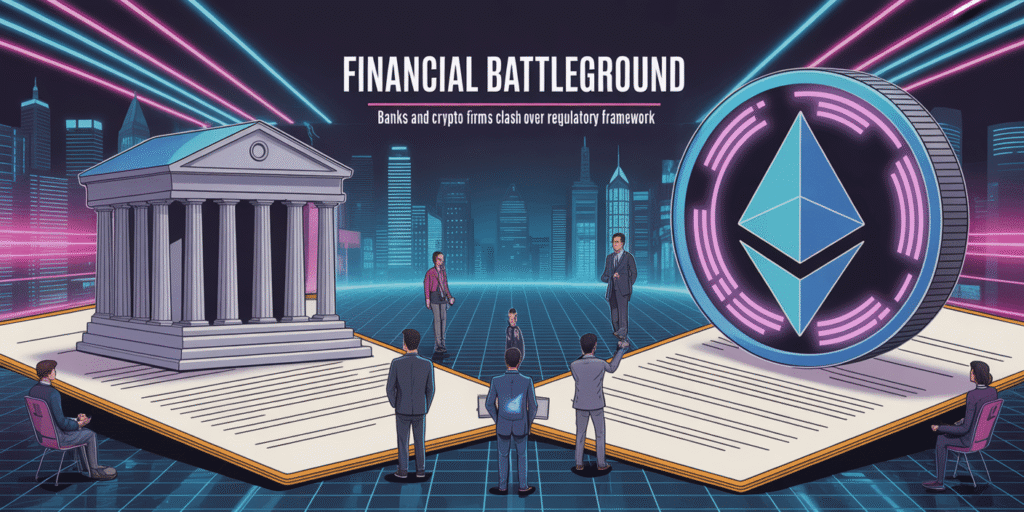
Jamie Dimon just issued a warning to crypto, but the industry is firing back harder.
The gloves are off in what may be the most consequential financial power struggle of our generation. On one side: legacy banking institutions that have controlled global money flows for centuries. On the other: a decentralized movement promising to democratize finance and strip power from gatekeepers. What’s happening right now isn’t just ideological posturing—it’s an existential war over who controls the infrastructure of tomorrow’s economy.
THE BANKING ESTABLISHMENT’S FEAR
Dimon’s Crypto Crusade
JPMorgan Chase CEO Jamie Dimon has never been shy about his contempt for cryptocurrency. He’s called Bitcoin a “fraud,” compared it to a “pet rock,” and suggested governments should shut down cryptocurrencies altogether. In recent testimony before Congress, Dimon doubled down, warning that crypto enables “money laundering, drug trafficking, sex trafficking, and terrorism.”
But here’s what’s interesting: JPMorgan has simultaneously invested heavily in blockchain technology, launched its own digital currency (JPM Coin), and offers crypto services to wealthy clients. The contradiction isn’t subtle—it’s strategic.
Convert Your Cryptocurrency to Cash On Xbanka
The Real Reasons for Banking Hostility
Strip away the public moralizing, and three core threats emerge:
1. Disintermediation
Traditional banks profit by standing between you and your money. International transfers, currency exchanges, savings accounts, every transaction generates fees because banks control the rails. Cryptocurrency eliminates the middleman entirely. Why pay $50 and wait three days for an international wire when you can send stablecoins globally in minutes for pennies?
2. Revenue Erosion
The numbers tell the story. JPMorgan alone generates over $2 billion annually from international transaction fees. Bank of America pulls in similar figures. Now multiply that across the entire global banking system. Crypto-based payment networks like Lightning, Ripple’s XRP Ledger, and stablecoin transfers directly threaten this revenue stream.
3. Loss of Monetary Surveillance
This is the quietest but most significant concern. Traditional banking gives governments and financial institutions complete visibility into your economic life. Every purchase, transfer, and transaction flows through monitored channels. Decentralized cryptocurrencies—especially privacy-focused ones—threaten this surveillance apparatus.
The Regulatory Capture Strategy
Dimon isn’t alone in his crusade. Senator Elizabeth Warren has called crypto “the new shadow banks,” pushing for regulations that would effectively force crypto companies to become… traditional banks. The irony is intentional.
Central bankers worldwide have echoed similar concerns while simultaneously developing CBDCs (Central Bank Digital Currencies)—essentially government-controlled crypto that preserves surveillance and control while co-opting blockchain technology.
The pattern is clear: if you can’t kill crypto, regulate it into submission or create a controlled alternative.
Get the Best Rate for Yout Crptocurrecy On Xbanka
THE CRYPTO COUNTEROFFENSIVE
Ripple’s Legal War
While Dimon issues warnings from congressional hearings, crypto companies are fighting back in courtrooms. The Ripple vs. SEC lawsuit became a defining battleground.
In December 2020, the SEC sued Ripple Labs, claiming its XRP token was an unregistered security. The subtext was obvious: establish legal precedent to categorize most cryptocurrencies as securities, bringing them under SEC control and effectively neutering their decentralized nature.
Ripple refused to settle. Instead, they spent three years and over $200 million fighting. In July 2023, they won a partial victory when Judge Analisa Torres ruled that XRP sales on public exchanges are NOT securities. The decision sent shockwaves through both the crypto and traditional finance worlds.
CEO Brad Garlinghouse didn’t mince words: “This case was never about Ripple. It was about the entire crypto industry, and whether innovation would be allowed to flourish or be strangled by regulatory overreach designed to protect incumbent financial institutions.”
The Technology Advantage
Beyond legal battles, crypto is winning on pure technological merit:
Speed: Bitcoin settles in minutes to hours. XRP settles in 3-5 seconds. Traditional international wire transfers? 3-5 business days.
Cost: Sending $100,000 internationally via traditional banking costs $500-2,000 in fees. Via crypto? Often under $1.
Accessibility: Over 1.7 billion adults remain unbanked globally—excluded from traditional finance due to documentation requirements, minimum balances, or geographic limitations. All they need for crypto is an internet connection.
Transparency: Every Bitcoin transaction is recorded on an immutable public ledger. Compare that to the 2008 financial crisis, where obscured bank practices nearly collapsed the global economy.
Institutional Adoption Accelerates
Despite—or perhaps because of—banking resistance, institutional adoption is accelerating:
– BlackRock, the world’s largest asset manager, launched a Bitcoin ETF that accumulated $10 billion in assets within months
– PayPal and Visa now process crypto transactions
– El Salvador adopted Bitcoin as legal tender
– Major corporations like MicroStrategy, Tesla, and Square hold Bitcoin on their balance sheets
Even traditional banks are quietly offering crypto services to clients. Why? Because refusing to evolve means losing relevance.
DeFi: The Nuclear Option
Decentralized Finance (DeFi) represents crypto’s most existential threat to banking. Platforms like Aave, Uniswap, and Compound offer lending, borrowing, and trading—all without banks, without permission, and without gatekeepers.
You can earn 5-8% yields on stablecoins while traditional savings accounts offer 0.5%. You can borrow against crypto collateral instantly, without credit checks. You can trade 24/7/365 without waiting for markets to open.
This isn’t theoretical. DeFi protocols manage over $50 billion in total value locked (TVL), processing billions in weekly volume—all outside traditional banking control.
THE STAKES OF THIS BATTLE

If Traditional Finance Wins
Imagine banking institutions successfully lobby for regulations that force all crypto companies to become traditional financial institutions—complete with KYC requirements that exclude the unbanked, transaction limits, operating hours, and government surveillance of every transaction.
We’d see:
– Increased financial surveillance and erosion of privacy
– Continued exclusion of billions from the global economy
– Preservation of extractive fee structures
– Innovation stifled by compliance costs that only large institutions can afford
This isn’t dystopian speculation. It’s the current banking system extended into the digital age.
If Crypto Wins
A crypto-dominant future promises:
– Financial sovereignty: You truly own your assets, not merely have claims against a bank
– Global accessibility: Anyone with internet access can participate in the global economy
– Reduced extraction: Competitive markets for financial services drive down predatory fees
– Innovation explosion: Programmable money enables use cases we haven’t imagined
– Reduced systemic risk: Decentralization prevents “too big to fail” scenarios
The Likely Reality: Coexistence
Total victory for either side is unlikely. What we’re witnessing is the painful birth of a hybrid system.
Traditional banks will adapt or die. Some, like JPMorgan (despite Dimon’s rhetoric), are already building blockchain infrastructure. Others will partner with crypto companies. Some will simply be replaced.
Meanwhile, crypto will face regulation—but hopefully smart regulation that prevents fraud without killing innovation. The question is whether regulations protect consumers or protect incumbent monopolies.
Why This Matters to You
This battle isn’t academic. The outcome determines:
– Whether you can transact privately or under constant surveillance
– Whether you pay 3% for international transfers or 0.1%
– Whether the 1.7 billion unbanked people gain financial access
– Whether innovation in finance flourishes or stagnates
– Whether you truly own your wealth or merely hold bank IOUs
The power to choose is shifting to individuals. Platforms that offer instant crypto trading, competitive rates, and 24/7 access represent this new paradigm. The old guard can issue warnings, but they can’t stop people from choosing better alternatives.
The Verdict
Jamie Dimon’s warnings reveal fear, not strength. When the CEO of America’s largest bank spends congressional testimony attacking a technology instead of explaining how his institution provides superior value, the subtext is obvious: crypto is winning, and legacy finance knows it.
Ripple’s legal victories, accelerating institutional adoption, DeFi’s explosive growth, and the simple fact that millions worldwide choose crypto daily despite banking opposition—these aren’t anomalies. They’re market signals.
The battle for financial control isn’t over, but the trajectory is clear. The question isn’t whether decentralized finance will play a role in our future—it’s how large that role will be, and whether you’ll be positioned to benefit from the transition or be left defending an increasingly obsolete system.
Choose wisely. The future of your financial sovereignty depends on it.
Frequently Asked Questions
Q: Why is Jamie Dimon against cryptocurrency if JPMorgan uses blockchain?
A: JPMorgan distinguishes between blockchain technology (which they control) and decentralized cryptocurrencies (which they don’t). Dimon’s opposition targets cryptocurrencies that threaten banking revenue and control, while JPMorgan invests in blockchain systems that keep banks as intermediaries. It’s not about the technology—it’s about who controls it.
Q: How did Ripple’s lawsuit victory impact the crypto industry?
A: Ripple’s partial victory established important legal precedent that cryptocurrency sales on public exchanges are not automatically securities. This challenged the SEC’s broad regulatory overreach and gave the entire crypto industry a path to operate without being forced under securities regulations designed for traditional stocks. It signaled that crypto could resist regulatory capture by legacy finance.
Q: What are the main advantages crypto has over traditional banking?
A: Crypto offers superior speed (transactions in seconds vs. days), dramatically lower costs (often under $1 vs. $50+ for international transfers), 24/7 accessibility, financial inclusion for the unbanked, transparent immutable records, and true ownership of assets without relying on bank solvency. These aren’t marginal improvements—they’re fundamental advantages.
Q: Can traditional banks really compete with decentralized finance?
A: Banks have advantages like established trust, regulatory compliance, and fiat integration. However, they struggle to match DeFi’s efficiency, speed, and low costs due to legacy infrastructure and profit models based on intermediation. The likely outcome is hybrid models where banks adopt blockchain technology while competing with pure DeFi protocols in certain areas. Adaptation, not elimination, is most realistic.
Q: What should individuals do in this banks vs. crypto battle?
A: Educate yourself on both systems, diversify your approach, and maintain financial optionality. Don’t rely solely on either traditional banking or crypto. Use banks for stability and regulatory protections where needed, but explore crypto platforms for better rates, faster transactions, and financial sovereignty. The power shift means individuals can now choose the best tools for each use case rather than being locked into a single system.