

Crypto vs Real Estate: Best Investment for Nigerians
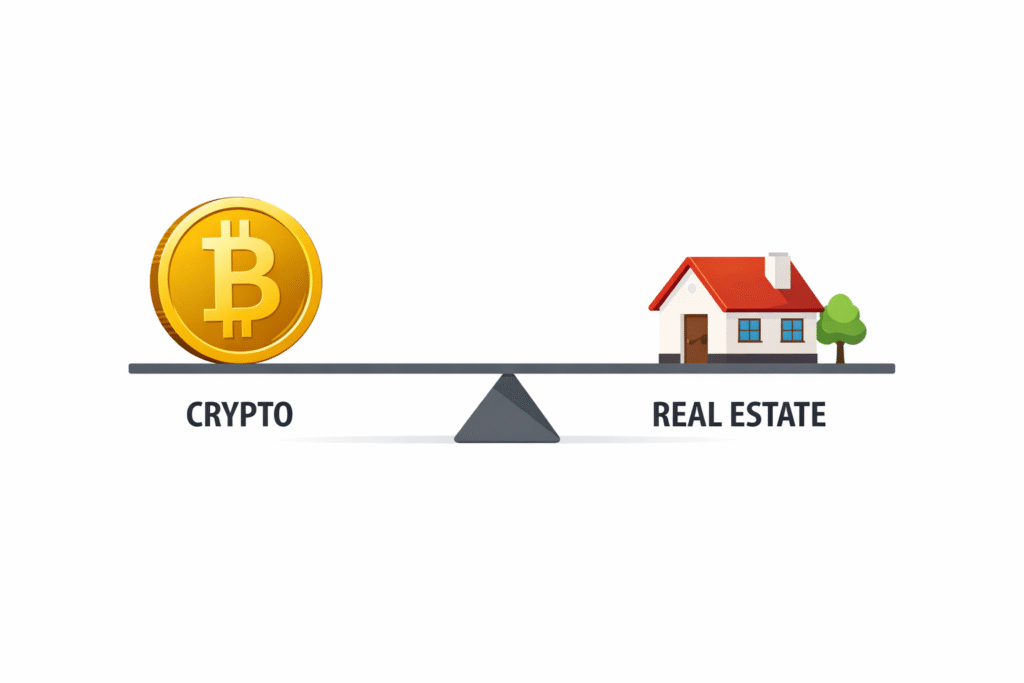
Which investment actually works in Nigeria: Crypto vs Real Estate?
For Nigerian investors navigating persistent naira devaluation, double-digit inflation, and limited capital, this question isn’t academic; it’s existential. While your parents’ generation built wealth through land and property, today’s economic reality demands a hard look at whether traditional real estate still makes sense, or if cryptocurrency offers a better path to preserving and growing wealth.
Let’s cut through the noise with data-driven analysis of both investment options in the Nigerian context.
The Real Returns: Numbers Don’t Lie
Bitcoin’s Naira Performance (2019-2026)
In January 2019, Bitcoin traded around ₦1.3 million. By December 2024, it reached approximately 145 million naira—a staggering 11,000% return in naira terms. Even accounting for Bitcoin’s notorious volatility, someone who invested ₦100,000 in early 2019 would have over ₦11 million today.
But here’s what matters more: the dollar-adjusted returns. Bitcoin went from roughly $3,700 to $97,000 in USD terms during this period—a 2,500% increase. The additional naira gains came from our currency’s devaluation from ₦360/$ to ₦1,500/$.
This dual benefit is crucial: crypto appreciates in dollar terms and benefits from naira weakness.
Real Estate’s Performance
Nigerian real estate tells a more complex story. According to industry data, prime Lagos properties appreciated roughly 40-60% in naira terms between 2019-2026. A ₦50 million property in Lekki Phase 1 might now be worth ₦70-80 million.
Sounds impressive until you account for:
Naira Devaluation Impact: That ₦50 million property was worth $138,888 in 2019. At ₦75 million today, it’s only worth $50,000 at current rates—a 64% loss in dollar terms.
Hidden Costs:
– Legal fees (5-10% of property value)
– Agency fees (5% for buyer, 5% for seller)
– Survey and documentation (₦500,000 – ₦2 million)
– Annual property taxes
– Maintenance and repairs
– Governor’s consent fees (3-5%)
After these costs, many real estate “gains” barely match inflation, let alone beat it.
The Capital Requirements Gap
This is where the comparison gets interesting for average Nigerians:
Real Estate Entry Point:
– Decent Lagos property: ₦15-50 million minimum
– Land in emerging areas: ₦5-10 million
– Added costs before purchase: ₦1-3 million (verification, legal, agency)
Crypto Entry Point:
– Minimum investment: As low as ₦5,000
– Transaction fees: 1-2% on exchanges
– No legal fees, surveys, or documentation costs
A young professional earning ₦200,000 monthly can realistically invest in crypto. Real estate remains out of reach unless they save for years or obtain loans with expensive interest rates (18-25% annually).
Transaction Costs: The Silent Killer
Real estate transaction costs in Nigeria are brutal:
– Buying: 10-15% of property value
– Selling: Another 8-12%
– Total round-trip: 20-27% of your investment
Your property needs to appreciate over 25% just to break even after one buy-sell cycle.
Crypto transaction costs:
– Exchange fees: 0.5-2%
– Conversion to naira via platforms like Xbankang: Competitive rates with instant settlement
– Total round-trip: 2-4%
You’re already ahead by 20+ percentage points before considering appreciation.
Liquidity and Accessibility: When You Need Your Money
Nigeria’s economic volatility makes liquidity a critical factor most investors overlook.
The Real Estate Liquidity Problem
Try selling a property in Nigeria quickly. You’ll discover:
Timeline: 6-18 months average to find a serious buyer and complete documentation
Price Concessions: Desperate sellers often discount 15-30% below market value for quick sales
Legal Complexities:
– Verifying genuine Certificate of Occupancy (C of O)
– Clearing government encumbrances
– Obtaining governor’s consent for transfer
– Resolving family/community land disputes
Geographic Lock: Your property is tied to one location. If that area declines (security issues, infrastructure collapse, flooding), your investment suffers.
Real estate is excellent for long-term wealth storage—if you can afford to have capital locked away for years and don’t mind the stress of property management.
Crypto’s Liquidity Advantage
Cryptocurrency offers unprecedented liquidity for Nigerian investors:
24/7 Access: Trade or convert anytime, including weekends and holidays
Instant Conversion: Platforms like Xbankang allow you to convert crypto to naira within minutes, not months. When you need funds urgently—medical emergency, business opportunity, school fees—your investment is accessible immediately.
No Geographic Limits: Your crypto works whether you’re in Lagos, Abuja, or relocating abroad. No property manager needed, no physical inspection required.
Fractional Liquidity: Need ₦50,000? Sell exactly that amount of crypto. With real estate, you can’t sell “half a property” to cover a smaller expense.
Best Rates, Instant Payment*: When cashing out, platforms like *Xbankang provide competitive conversion rates with instant naira payment to your bank account. No waiting weeks for bank transfers or dealing with shady P2P traders who might reverse transactions.
This liquidity matters enormously in Nigeria’s unpredictable economy. The ability to access your wealth instantly, at fair rates, can mean the difference between seizing opportunities and watching them pass.
The Accessibility Revolution
Crypto democratizes investing in ways real estate never could:
Start Small, Scale Up: Begin with ₦10,000, add ₦5,000 monthly. This dollar-cost averaging approach builds wealth gradually—impossible with real estate’s large minimums.
No Gatekeepers: No need to know a “real estate guy,” no bribing government officials for documentation, no dealing with corrupt lawyers. Just you, your phone, and an internet connection.
Education Barriers: While both require learning, crypto resources are abundant and free online. Real estate requires insider knowledge about neighborhoods, property values, and legal processes that take years to acquire.
Portfolio Strategy: The Smart Nigerian Investor’s Approach

Here’s the truth neither crypto maximalists nor real estate gurus want to admit: the question isn’t crypto OR real estate—it’s how much of each.
Allocation by Capital Level
If You Have Under ₦5 Million to Invest:
– 80% Crypto (Bitcoin, Ethereum for core holdings)
– 20% High-yield savings (emergency fund)
– Real estate isn’t realistic yet—don’t force it
If You Have ₦5-20 Million:
– 60% Crypto (diversified across major coins)
– 30% Real estate (land in emerging areas, REITs)
– 10% Emergency fund
If You Have ₦20+ Million:
– 40% Crypto (for growth and dollar hedge)
– 50% Real estate (rental properties for passive income)
– 10% Other (stocks, bonds, emergency fund)
Risk Management for Nigerian Conditions
The Nigerian investment environment requires specific strategies:
Crypto Risk Mitigation:
– Hold long-term to ride out volatility (minimum 4-year horizon)
– Use reputable platforms like Xbankang for conversions to avoid scams
– Never invest more than you can afford to lose
– Diversify across 3-5 major cryptocurrencies
– Keep some stablecoins (USDT) for naira-hedge without full crypto volatility
Real Estate Risk Mitigation:
– Verify property documents with independent lawyers
– Prioritize areas with infrastructure development
– Consider rental properties in stable areas (Abuja, established Lagos zones)
– Avoid buying land in disputed communities
– Budget 30% above purchase price for unexpected costs
The Hybrid Strategy: Using Crypto Gains for Real Estate
Here’s a powerful approach many smart Nigerian investors are using:
1. Accumulate in crypto (2-4 years): Build wealth in Bitcoin/Ethereum with smaller monthly investments
2. Convert strategically: When crypto hits major gains, use Xbankang to convert a portion to naira at competitive rates with instant payment
3. Deploy to real estate: Use those naira gains as down payment for income-generating property
4. Reinvest rental income: Put rental yields back into crypto
This strategy leverages crypto’s growth potential and real estate’s stability. You’re using crypto as the wealth accumulation engine, then diversifying into real estate for passive income and physical asset ownership.
Tax and Regulatory Considerations
Nigeria’s regulatory environment for both assets is evolving:
Crypto: Currently not formally regulated, but not illegal. The CBN’s crypto trading restrictions on banks have pushed trading to P2P and specialized platforms. Use licensed platforms like *Xbankang that provide reliable service without the risks of informal trading.
Real Estate: Clear tax obligations including Capital Gains Tax (theoretically 10%, rarely enforced) and annual property taxes. Budget for these to avoid surprises.
Regulatory clarity will improve for both sectors. Until then, work with established platforms and document all transactions.
The Verdict: What Actually Works
For most Nigerians in 2024, cryptocurrency offers better risk-adjusted returns than real estate, especially if you:
– Have limited capital (under ₦10 million)
– Need liquidity and flexibility
– Want protection from naira devaluation
– Prefer lower transaction costs
– Can tolerate short-term volatility for long-term gains
Real estate still makes sense if you:
– Have substantial capital (₦20+ million)
– Want tangible assets and passive rental income
– Can afford to lock money away for 5+ years
– Have expertise in property markets
– Want to diversify an already-established portfolio
The optimal strategy for most Nigerians*: Start with crypto to build wealth quickly, then diversify into real estate as your capital grows. Use platforms like *Xbankang to convert crypto profits to naira instantly at competitive rates when you’re ready to make that real estate down payment.
Nigeria’s economic reality—currency devaluation, inflation, limited capital—actually favors crypto’s accessibility and global nature over real estate’s capital intensity and illiquidity. Your grandparents built wealth through land because that was the best option available. Today, you have better tools.
The question isn’t whether crypto or real estate is “better” in abstract terms. It’s which one matches your current capital level, liquidity needs, and financial goals in Nigeria’s specific economic environment.
For most reading this, the answer is clear: start with crypto, convert wisely using reliable platforms like Xbankang when you need naira, and graduate to real estate when you’ve built sufficient capital. That’s how you build lasting wealth in modern Nigeria.
Frequently Asked Questions
Q: How much do I need to start investing in crypto vs real estate in Nigeria?
A: You can start crypto investing with as little as ₦5,000-₦10,000 on most platforms. Real estate typically requires ₦5-15 million minimum for land in emerging areas, or ₦20-50 million for developed properties in cities like Lagos and Abuja. This massive difference in entry points makes crypto far more accessible for average Nigerians building wealth.
Q: Isn’t crypto too volatile for Nigerian investors?
A: While crypto experiences short-term volatility, Bitcoin has delivered over 11,000% returns in naira terms from 2019-2024, far outpacing real estate’s 40-60% gains. The key is investing only what you can afford to hold for 3-5 years. For Nigerians facing naira devaluation, crypto’s dollar-denominated growth actually provides stability that naira assets can’t match. Keep 3-6 months of expenses in stable savings, then invest surplus in crypto long-term.
Q: How do I convert my crypto to naira when I need cash?
A: Use established platforms like Xbankang that offer instant crypto-to-naira conversion at competitive rates. Unlike informal P2P trading where you risk scams and reversed transactions, Xbankang provides instant payment directly to your bank account with 24/7 support. This makes crypto practically as liquid as a savings account, but with much better returns.
Q: Can I invest in both crypto and real estate?
A: Absolutely—this is actually the smartest strategy for investors with ₦5 million+ in capital. A common approach is to build wealth in crypto first (taking advantage of its high growth and low entry point), then use platforms like Xbankang to convert gains to naira for real estate down payments. This hybrid strategy uses crypto for growth and real estate for stability and passive rental income.
Q: What are the real transaction costs for real estate in Nigeria?
A: Total transaction costs for buying and selling property in Nigeria typically range from 20-27% of the property value. This includes legal fees (5-10%), agency fees (10% combined), survey costs (₦500,000-₦2 million), and governor’s consent (3-5%). In contrast, crypto transaction fees including conversion via platforms like Xbankang total just 2-4%. Your property must appreciate over 25% just to break even after one buy-sell cycle.